
A loan can seem like a quick answer when money is tight. You fill out an application, receive the funds, and agree to make payments. Sometimes the real cost does not become clear until later.
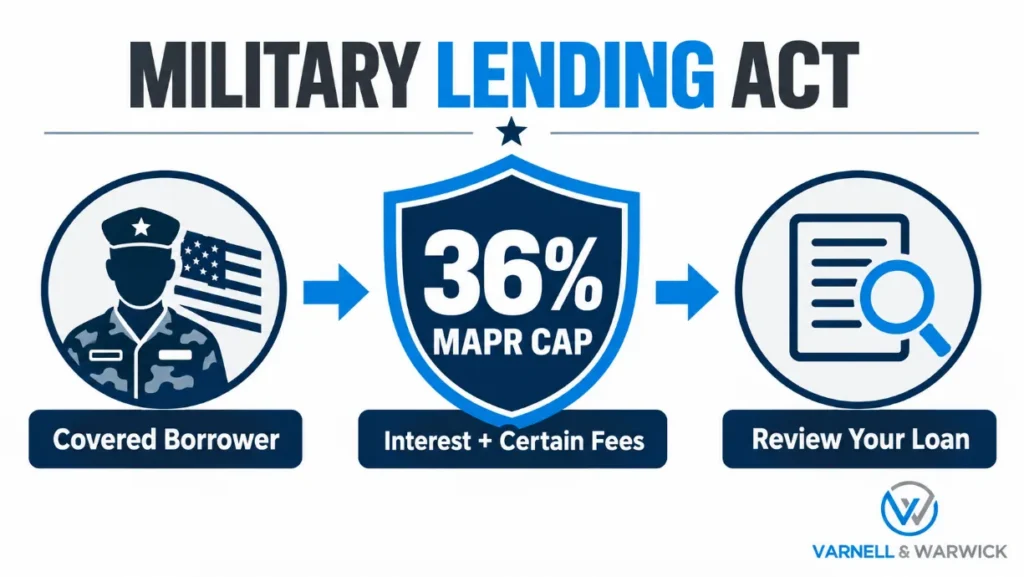
If you received a CashNetUSA loan while you were on active duty, federal law may cap the amount you could be charged. The Military Lending Act generally places a 36% cap on the Military Annual Percentage Rate, also called MAPR, for covered consumer credit.
If you are on active duty and you received a CashNet USA loan, that loan may violate the MLA.
This article explains the basic protections and the information that may help an attorney review your situation.
Contact Us
case@vandwlaw.com
Key Takeaways
- A covered servicemember generally cannot be charged more than a 36% MAPR on covered consumer credit.
- MAPR can include interest, fees, and certain additional products.
- The regular APR and MAPR are not always the same.
- You generally must have been a covered borrower when the credit was extended.
- Not every type of loan falls under the Military Lending Act.
- A CashNetUSA military loan showing a high rate may deserve a legal review, but the rate alone does not prove a violation.
- Keep your loan agreement, statements, payment records, emails, and proof of military service.
What Is the Military Lending Act?
The Military Lending Act, or MLA, is a federal law that gives certain financial protections to active-duty servicemembers and their covered dependents.
One of its most important rules concerns the cost of borrowing money. A creditor generally cannot require a covered borrower to pay a MAPR higher than 36% on a covered loan.
The law also restricts certain loan terms. For example, a lender generally cannot require a covered borrower to submit to mandatory arbitration, use a military allotment to repay the loan, or pay a penalty for paying the loan off early.
These protections matter because a short-term loan can become expensive very quickly. A fee may look small when shown as a dollar amount. Once it is included in an annual rate calculation, though, the total borrowing cost may look quite different.
What Does the 36% Limit Include?
The 36% limit applies to MAPR. It is important not to confuse that number with the regular interest rate printed in large type on an advertisement.
MAPR may include:
- Interest
- Finance charges
- Credit insurance premiums
- Fees for certain add-on credit products
- Application or participation fees, with some exceptions
- Certain service and renewal charges
- Other charges connected to the credit
This is why reviewing a CashNetUSA military loan may require more than finding one percentage on the agreement. A stated interest rate might be below 36%, while additional charges could affect the MAPR. The opposite is possible too, depending on the product and how federal rules apply.
It can feel confusing. Honestly, it often is. An attorney may need to review the complete agreement and calculate which charges count.
The Consumer Financial Protection Bureau provides more information about the 36% MAPR limit and other MLA protections.
Who Qualifies as a Covered Borrower?
The MLA does not apply to every person who has served in the military.
Covered borrowers generally include:
- Active-duty members of the Army, Navy, Air Force, Marine Corps, Coast Guard, and Space Force
- Reservists serving on qualifying active duty
- National Guard members serving under qualifying federal orders
- Spouses of covered servicemembers
- Certain covered dependents
Timing is a major part of the review. A person who is active duty today might not have been covered when the loan was issued. Someone who has now left the military may have been covered on the date of the agreement.
If you received a CashNetUSA loan, find the exact date the credit was issued. Then compare that date with your military orders or service records. A few days can matter, which may seem overly technical, but the timing should not be guessed.
Does the MLA Cover Every Type of Loan?
No. The Military Lending Act covers many common forms of consumer credit, but it has exceptions.
Covered credit can include:
- Payday loans
- Many installment loans
- Deposit advance products
- Vehicle title loans
- Overdraft lines of credit
- Certain student loans
- Credit cards
Some loans are generally excluded. These may include residential mortgages and certain loans used to purchase a motor vehicle or personal property when the loan is secured by the property being purchased.
The name of a loan does not always provide the full answer. The actual purpose, structure, and security for the debt may need to be examined.
For this reason, a borrower should not assume that every personal or installment loan is covered. An attorney should first identify the exact product involved.
Contact Us
case@vandwlaw.com

What If the Agreement Shows a Rate Above 100%?
A rate above 100% is hard to overlook. It can be shocking, especially when a borrower did not understand how expensive the loan would become.
If your CashNetUSA military loan displays a triple-digit APR, that is an important fact to save and consult with an attorney. However, a high APR does not by itself establish every part of an MLA claim.
A proper review should answer several questions:
- Were you a covered borrower when the loan was issued?
- Was this loan covered consumer credit?
- Which company legally extended the credit?
- What was the MAPR, not only the stated APR?
- Which fees and charges were included?
- When did the possible violation occur?
- When did you discover the possible problem?
A 100% APR is above the MLA limit. Still, the final legal conclusion should come after the documents and facts are reviewed.
APR and MAPR Are Not Always Identical
APR means annual percentage rate. MAPR means Military Annual Percentage Rate. The terms sound similar, so borrowers sometimes treat them as the same thing.
They may not be.
The Truth in Lending Act generally controls how ordinary APR is calculated. MAPR uses a broader calculation for covered military borrowers and may include charges that the regular APR leaves out.
Suppose a loan has interest plus an added product fee. The ordinary APR may account for the interest and some finance charges. MAPR may also count the added fee, depending on what it was for and how it was charged.
That is one reason a legal review should include the entire CashNetUSA military loan agreement. Looking only at the payment amount or advertised interest rate may leave out important information.
Military Lending Act or SCRA?
The Military Lending Act and the Servicemembers Civil Relief Act are different laws. They are sometimes mixed together, but they do different jobs.
The MLA generally covers certain consumer credit extended while a person is a covered servicemember or dependent. Its rate limit is generally 36% MAPR.
The SCRA can limit interest to 6% on certain debts incurred before a servicemember entered military service. It may require the servicemember to notify the creditor and provide military orders or another appropriate indicator of service.
So, the date of the debt matters again.
- A covered loan obtained during qualifying active duty may raise an MLA issue.
- A debt obtained before entering military service may raise an SCRA issue.
- In some situations, neither law may apply.
It is better to determine which law fits instead of placing every military debt under the same rule.
What Could Happen If a Loan Violated the MLA?
Federal law provides several possible remedies for an MLA violation.
A prohibited credit agreement may be considered void from the beginning. A borrower may also be able to seek actual damages, with a statutory minimum of $500 for each violation, appropriate punitive damages, equitable or declaratory relief, and other available relief.
In a successful case, the law may also allow the borrower to recover court costs and reasonable attorney fees. A knowing violation can carry criminal penalties, but it would be wrong to call every possible violation a crime before intent and the other facts are established.
Whether these remedies apply to a particular CashNetUSA military loan depends on the evidence. No result should be promised before that review.
The statutory protections and remedies appear in 10 U.S.C. § 987.
Contact Us
case@vandwlaw.com
Documents That May Help With a Review
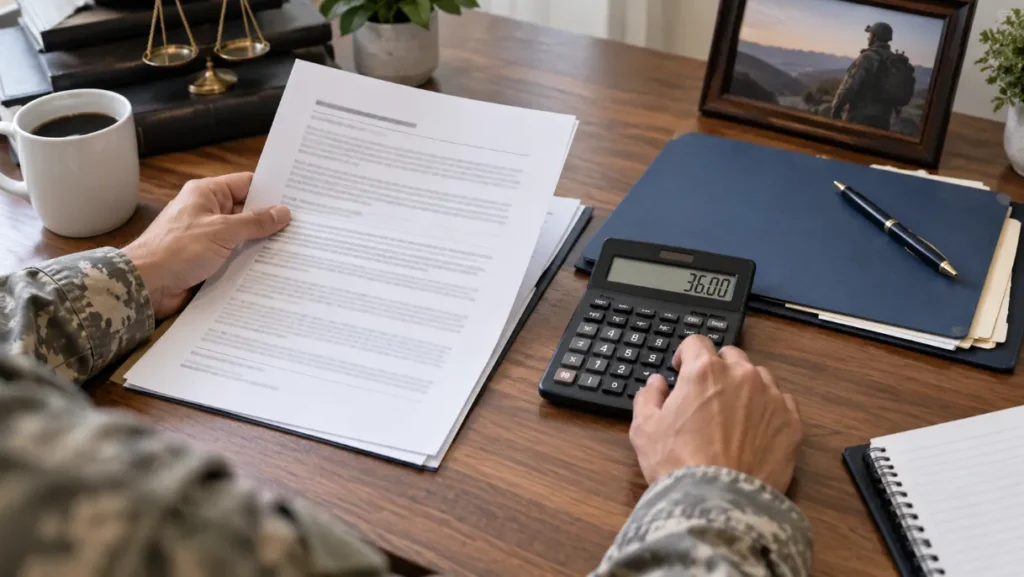
You do not need to calculate everything before contacting an attorney. Just try to gather what you have.
Helpful records may include:
- The original loan agreement
- Truth in Lending disclosures
- Account statements
- Payment history
- Bank statements showing withdrawals
- Emails or text messages about the loan
- Screenshots from your online account
- Records of fees or loan renewals
- Military orders
- Proof of active-duty status
- Records showing when you entered or left active duty
- Letters or complaints previously sent to the lender
Do not change or mark up the original files. Save copies instead. If the account is still available online, downloading the documents now may be helpful. Online records do not always remain available forever.
These documents can help establish the lender, loan date, charges, payments, and military status.
When Should You Speak With an Attorney?
Consider requesting a review if:
- You obtained a genuine CashNetUSA loan while on active duty.
- The agreement displays a rate above 36%.
- The loan included several fees or added products.
- You were required to use a military allotment.
- The contract required arbitration.
- You paid a prepayment penalty.
- You are unsure how the MAPR was calculated.
- You still have the agreement or payment records.
There are time limits for bringing an MLA claim. Federal law generally uses the earlier of two deadlines: two years after discovering the violation or five years after the violation occurred. How those rules apply may depend on the facts.
Waiting can make documents harder to locate. It may also affect legal options.
Talk With Varnell & Warwick About Your Loan
At Varnell & Warwick, we represent consumers facing unfair lending practices and corporate wrongdoing. We know that taking on a lender can feel difficult. Most people do not know where to begin, and that is understandable.
If you received a CashNetUSA loan while you were protected by the Military Lending Act, our attorneys can review the available information and help determine whether further action may be appropriate.
We may examine your active-duty status, loan date, agreement, fees, APR, MAPR, payment records, and other terms. A very high rate can be an important warning sign, but every case must be considered on its own facts.