When people compare loan offers, they often focus on the interest rate or monthly payment. Those numbers matter, but they may not reveal the full cost of borrowing. This is especially important when a CashNetUSA loan is extended to an active-duty servicemember or their spouse, also referred to as a “covered borrower.”
CashNetUSA offers consumer credit to the general public. However, when a covered borrower is extended credit, the Military Lending Act may apply.
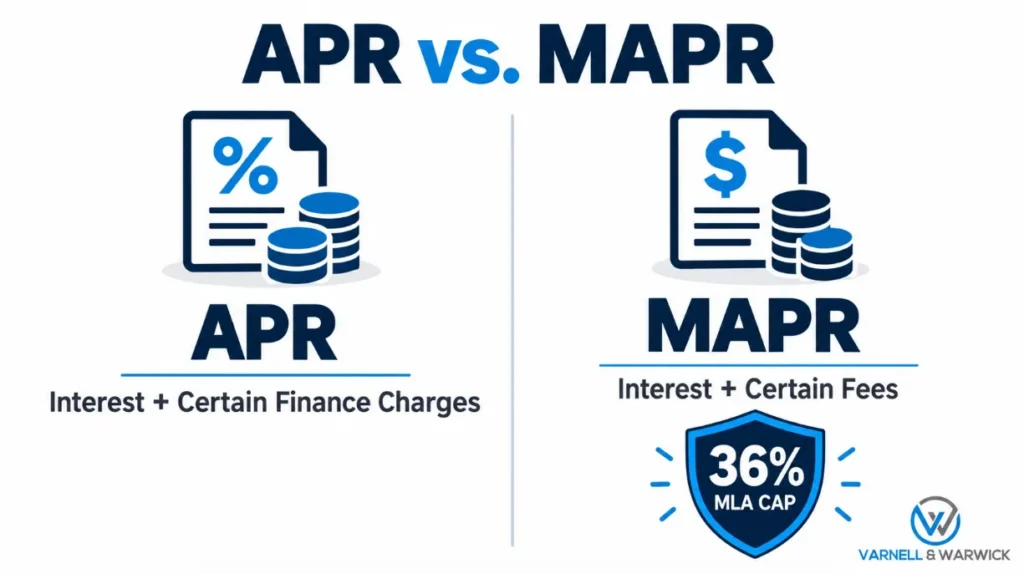
One of the law’s protections is a 36% limit on the Military Annual Percentage Rate, commonly called MAPR. MAPR may include charges that are not counted in the standard annual percentage rate, or APR.
At Varnell & Warwick, we understand that the difference can be difficult to spot. A borrower may see one percentage in an advertisement, another in the agreement, and several separate fees on account statements. Determining which rate matters requires a review of the borrower, the credit product, and the charges connected to the account.
Key Takeaways
- CashNetUSA offers regular consumer credit, not a special military lending product.
- The MLA may apply when covered consumer credit is extended to an active-duty servicemember or another covered borrower.
- The MLA generally limits MAPR to 36%.
- APR and MAPR are not always the same.
- MAPR may include interest, finance charges, credit insurance, and certain add-on fees.
- Not every servicemember or credit transaction is covered.
- The borrower’s status when the account was opened can be important.
- Loan agreements, statements, fee records, and military documents may help with a legal review.
What Is APR?
APR stands for annual percentage rate. It gives consumers a way to compare the cost of different credit products.
APR generally includes the interest rate and certain finance charges required under the Truth in Lending Act and Regulation Z. It can therefore provide more information than the interest rate alone.
For example, imagine that two loans have the same basic interest rate. One loan also has a finance charge that must be included in its APR. That additional cost could cause the loan to have a higher APR.
Creditors generally disclose APR when offering covered consumer credit. However, the standard APR calculation may not include every fee or add-on product associated with an account.
What Is MAPR?
MAPR stands for Military Annual Percentage Rate. It is the annual cost measure used under the Military Lending Act.
MAPR applies when a creditor extends covered consumer credit to a covered borrower. It may include more charges than the regular APR calculation.
Depending on the transaction, MAPR may include:
- Interest and other finance charges
- Credit insurance premiums or fees
- Debt cancellation fees
- Debt suspension fees
- Fees for credit-related add-on products
- Certain application fees
- Certain participation fees
Because MAPR can include additional charges, it may be higher than the APR shown in the loan documents. That is why borrowers should not rely on one advertised percentage when trying to understand whether the MLA’s cost limit may apply.
What Is the Main Difference Between APR and MAPR?
The main difference is which borrowing costs are included.
APR is calculated under the general consumer credit rules in Regulation Z. MAPR uses a related calculation but includes additional charges identified by the Military Lending Act regulations.
Suppose a CashNetUSA account has interest plus a fee for a credit-related add-on product. The standard APR may not treat that fee in the same way that MAPR does. If the fee must be included in MAPR, the total cost used for the MLA analysis could be higher than the disclosed APR.
The exact calculation depends on the type of credit and how each charge was imposed. A complete review may require the original agreement, statements, payment records, and documents for any additional products.
Which Rate Controls the MLA’s 36% Limit?
MAPR is the rate used to apply the Military Lending Act’s 36% limit.
A creditor generally may not impose an MAPR greater than 36% on covered consumer credit extended to a covered borrower.
This does not mean every loan issued to an active-duty servicemember is automatically subject to the 36% cap. Two main questions must first be answered:
- Was the person a covered borrower at the relevant time?
- Was the transaction covered consumer credit under the MLA?
If either requirement is missing, the MLA may not apply. The transaction could still be governed by other federal or state consumer laws.
Who Is Considered a Covered Borrower?
A covered borrower generally includes a qualifying covered member of the armed forces or the qualifying dependent of a covered member.
A covered member generally includes someone serving:
- On qualifying active duty under Title 10, 14, or 32 pursuant to an order that does not specify a period of 30 days or fewer
- On Active Guard and Reserve duty
Qualifying spouses, children, and certain other dependents may also be protected.
Timing is important. Covered status is generally determined when the consumer becomes obligated on the credit transaction or establishes the credit account.
A person who is serving on active duty today may not have had covered status when an older account was opened. Likewise, someone who has left active duty may have had covered status when the transaction began.
Borrowers should identify the account-opening date and compare it with military orders, service records, or dependent-status records.
Is CashNetUSA Required to Check Military Status?
The MLA regulations permit creditors to determine whether an applicant is a covered borrower. They also provide safe-harbor methods for making that determination.
A creditor may check the Department of Defense’s covered-borrower database. It may also use a qualifying military-status indicator obtained through a nationwide consumer reporting agency.
However, the database check itself is not the central question for the borrower. The more important issue is whether the person actually had covered-borrower status at the relevant time and whether the transaction was covered by the law.
Failing to find evidence of a database search does not, by itself, answer every legal question. An attorney should examine the full facts and applicable safe-harbor rules.
What Types of Consumer Credit May Be Covered?
The MLA generally applies to credit offered or extended primarily for personal, family, or household purposes when it involves a finance charge or is payable under a written agreement in more than four installments.
Depending on the facts, covered consumer credit may include:
- Payday loans
- Vehicle title loans
- Installment loans
- Lines of credit
- Credit cards
- Other qualifying consumer credit products
However, the law contains important exceptions.
Residential mortgages are generally excluded. Credit expressly intended to finance the purchase of a motor vehicle may also be excluded when the credit is secured by the vehicle being purchased.
A similar exception may apply to credit expressly intended to purchase personal property when that property secures the transaction.
The name given to a credit product does not settle the issue. Its purpose, payment structure, security, and other terms may need to be examined.
Can an APR Be Higher Than 36%?
The MLA specifically limits MAPR, not the standard APR by itself.
A high APR can be a serious warning sign. If the stated APR is already above 36%, it may be reasonable to investigate whether the MAPR also exceeded the limit. Still, APR alone does not establish every part of an MLA claim.
A proper review should determine:
- Whether the borrower had covered status
- When the account was opened
- Whether the transaction was covered consumer credit
- What APR was disclosed
- Which interest and fees were charged
- Whether add-on products were included
- Which charges counted toward MAPR
- Whether the resulting MAPR exceeded 36%
The correct legal conclusion depends on all these facts together.

What Disclosures Should a Covered Borrower Receive?
For covered consumer credit, a creditor generally must provide certain information before or when the borrower becomes obligated on the transaction or establishes the account.
The required information generally includes:
- A statement describing the MAPR and charges that may be included
- Disclosures required under Regulation Z
- A clear description of the borrower’s payment obligation
What Other Protections Does the MLA Provide?
The 36% MAPR cap is only one part of the Military Lending Act. The law also restricts certain terms and practices involving covered consumer credit.
Depending on the transaction, a creditor generally may not:
- Require a covered borrower to accept mandatory arbitration
- Require the borrower to waive certain legal rights
- Require repayment through a military allotment
- Use certain improper forms of account access as security
- Charge a penalty for paying the debt early
These provisions are separate from the MAPR limit. A transaction may therefore require review even when the borrower is unsure of the exact rate.
Why This Matters to CashNetUSA Borrowers
Someone may have received a regular CashNetUSA loan for personal or household expenses without realizing that the MLA could apply.
An active-duty servicemember or qualifying dependent may want to review a CashNetUSA account if:
- The agreement shows a high APR
- Several fees or add-on products were charged
- The borrower had covered status when the account opened
- MAPR was not clearly understood
- The agreement contains mandatory arbitration
- The borrower was asked to waive legal rights
- Repayment involved a military allotment
- A prepayment penalty was charged
These facts do not automatically prove a violation. They may show that the transaction deserves closer examination.
What Documents Should a Borrower Save?
Borrowers do not need to calculate MAPR before speaking with an attorney. They should begin by collecting the records they already have.
Useful documents may include:
- The original CashNetUSA agreement
- Account-opening disclosures
- Monthly statements
- Payment records
- Bank statements
- Fee schedules
- Add-on product documents
- Emails and text messages
- Online account screenshots
- Military orders
- Proof of active-duty service
- Records showing qualifying dependent status
Keep the original documents unchanged and store copies securely. If records are only available through an online account, downloading them may help preserve the information.
Questions to Ask About the Account
When reviewing the transaction, consider asking:
- What APR was disclosed?
- What interest and fees were charged?
- Were credit insurance or add-on products included?
- Which charges may count toward MAPR?
- Was the borrower covered when the account was opened?
- Does the transaction qualify as covered consumer credit?
- Did the agreement contain terms restricted by the MLA?
- Are complete statements and payment records available?
These questions provide a better starting point than simply asking whether the account was a “military loan.”
Talk With Varnell & Warwick About a CashNetUSA Account
At Varnell & Warwick, we help consumers examine lending practices and understand their potential legal rights. We know that loan agreements can be confusing, especially when APR, MAPR, fees, disclosures, and military status must all be considered together.
If you obtained a CashNetUSA loan while you were an active-duty servicemember or the spouse of someone on active-duty service, consider preserving your records and requesting a review.
Our attorneys may examine your military status, account-opening date, agreement, APR, fees, add-on products, MAPR-related charges, payment records, and other contract terms. Every matter depends on its own facts, and no outcome can be guaranteed before the documents are reviewed.