

The Military Lending Act protects active-duty service members and qualifying dependents. Federal law gives covered military borrowers protections that are not available in every ordinary lending situation. These protections include a limit on the total cost of covered credit and restrictions on certain loan terms.
At Varnell & Warwick, we understand that military lending cases can be difficult to evaluate. A loan agreement may display an annual percentage rate, but that number may not include every charge counted under federal military lending rules. When we examine a CashNetUSA Military Lending Act concern, we look beyond the advertised rate and review the borrower’s military status, the type of credit, the fees charged, and when the account was opened.
This article explains the basic protections available to military borrowers. It also discusses what records may help determine whether a particular loan requires closer legal review.
What Is the Military Lending Act?
The Military Lending Act, commonly called the MLA, is a federal law designed to protect active-duty service members and certain dependents when they use covered forms of consumer credit.
The law recognizes that high-cost lending can create serious problems for military families. Heavy debt may affect a service member’s financial stability, ability to support a family, and readiness to perform military duties.
The MLA does not prohibit all loans to service members. Instead, it limits the cost and terms of certain credit transactions. Whether the law applies depends on several facts, including the borrower’s status when the loan was made and whether the credit falls within the law’s definition of consumer credit.
Who Qualifies as a Covered Borrower?
A covered borrower generally includes a qualifying member of the armed forces serving on active duty for more than 30 days. Members serving on Active Guard and Reserve duty may also qualify.
Certain dependents may receive protection as well. Depending on the circumstances, this can include a service member’s spouse, children, and some other supported family members.
Timing matters. The borrower generally must have covered status when becoming obligated on the credit transaction or when establishing the account. A person who later enters active duty may not receive MLA protection for an account opened before covered status began.
Creditors can use the Department of Defense database or a qualifying military-status indicator from a nationwide consumer reporting agency to check whether an applicant is covered. These methods may provide a legal safe harbor when used correctly and when proper records are kept.
What Is the 36% MAPR Limit?
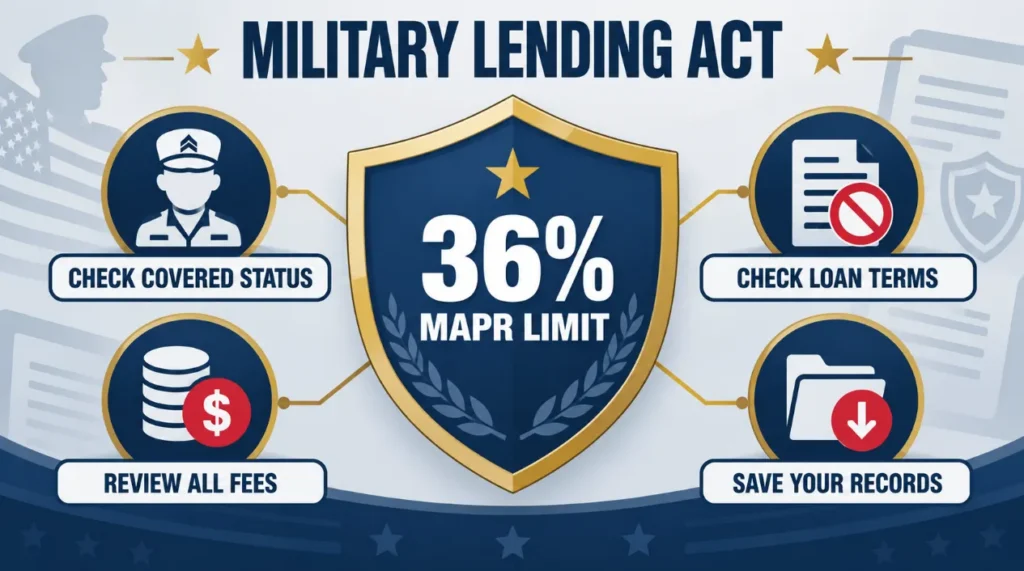
One of the most important MLA protections is the 36% limit on the Military Annual Percentage Rate, or MAPR. A creditor generally may not impose an MAPR greater than 36% on covered consumer credit provided to a covered borrower.
MAPR is not always the same as the regular annual percentage rate, or APR. APR generally reflects interest and certain finance charges under standard consumer credit laws. MAPR can include additional costs.
Depending on the transaction, MAPR may include:
- Interest and other finance charges
- Credit insurance premiums or fees
- Debt cancellation or debt suspension fees
- Charges for certain credit-related add-on products
- Certain application fees
- Certain participation fees
Some limited exclusions may apply, particularly to reasonable and bona fide credit card fees. Because the calculation can be technical, a stated APR below 36% does not always prove that the MAPR also stayed within the federal limit.
What a CashNetUSA Military Lending Act Claim May Involve
A complaint involving CashNetUSA alleges that certain loans were made to covered military borrowers at rates far above the MLA’s 36% MAPR limit. The complaint reportedly concerns an active-duty Army staff sergeant and his spouse, along with other potentially affected borrowers. It alleges that a line of credit was opened while the service member had covered status and carried an APR exceeding 200%.
These are allegations made in a lawsuit. They have not necessarily been established as facts or resolved by a final court decision. CashNetUSA and the other named defendants may dispute the allegations and raise legal or factual defenses.
Still, the case presents an important question for military consumers: Were covered borrowers given credit that complied with the MLA’s cost limit and other protections?
A Military Lending Act analysis should not stop with the APR printed on a statement. It may require a review of every finance charge, application cost, participation charge, and credit-related product connected to the account. Those amounts may affect MAPR even when they are not presented as ordinary interest.
What Types of Loans Can the MLA Cover?
The MLA generally applies to consumer credit offered for personal, family, or household purposes when the transaction has a finance charge or is payable under a written agreement in more than four installments.
Covered products may include certain:
- Payday loans
- Vehicle title loans
- Installment loans
- Lines of credit
- Credit card accounts
- Other high-cost consumer loans
However, the law contains exceptions. Residential mortgages are generally excluded. A loan specifically used to purchase a motor vehicle may also be excluded when the vehicle being purchased secures the loan. A similar exception may apply when credit is used to purchase personal property and that property secures the transaction.
The details matter. Borrowers should not assume a loan is covered or excluded based only on its name.
Other Protections Provided by the MLA
The 36% MAPR cap is only one part of the law. The MLA also restricts certain contract terms and lending practices involving covered credit.
Depending on the transaction, a creditor generally may not:
- Require a covered borrower to submit to mandatory arbitration
- Require the borrower to waive certain legal rights
- Require repayment through a military allotment
- Use a check or access to a deposit account as an improper form of security
- Charge a penalty for paying the debt early
Creditors must also provide certain disclosures before or when a covered borrower becomes obligated on a transaction. These generally include a statement describing the applicable MAPR, the disclosures required by Regulation Z, and a clear description of the payment obligation.
An ordinary APR disclosure does not replace all MLA requirements.
Warning Signs That a Loan May Need Review
A high interest rate is an obvious reason to examine a loan, but it is not the only warning sign. An active-duty borrower may want to obtain a legal review if:
- The APR is extremely high
- The lender did not discuss MAPR
- The agreement includes several unexplained fees
- Credit insurance or another add-on product was included
- The lender did not appear to check military status
- The contract contains a mandatory arbitration clause
- The borrower was asked to waive legal rights
- Payments were connected to a military allotment
- The balance remains high despite repeated payments
None of these facts automatically proves that a violation occurred. They may, however, show that the account deserves closer examination.

Documents Needed for a CashNetUSA Military Lending Act Review
Good records can make it easier to understand what happened. Borrowers should save or gather:
- The original application
- The credit agreement
- Account-opening disclosures
- Monthly statements
- Payment records
- Documents showing fees and interest
- Records for credit insurance or add-on products
- Emails and text messages from the lender
- Screenshots from the online account
- Military orders or proof of covered status
- Records showing the account-opening date
Do not alter the original documents. Keep digital copies in a secure location. If information is only available through an online account, download it before access changes or the account is closed.
Why the Account-Opening Date Matters
Military status is usually examined at the time the borrower enters the transaction or establishes the account. For that reason, the account-opening date can be just as important as the rate.
A borrower should compare that date with active-duty orders and other military records. Qualifying dependents should also gather documents showing their relationship to the covered service member at that time.
A later credit-limit increase or new advance may create additional legal questions. Whether it counts as a new extension of credit can depend on the agreement and the structure of the account. This issue should be evaluated based on the exact facts rather than assumed.
What Should an Affected Borrower Do?
Start by collecting the full agreement and payment history. Write down the date the account was opened, the amount borrowed, the stated APR, and every fee charged. Do not rely only on a current balance or a short account summary.
Next, confirm whether you or your qualifying family member had covered military status when the account began. If possible, preserve the military-status records that match that date.
Finally, consider having the transaction reviewed by an attorney who understands consumer credit and military lending protections. Calculating MAPR and determining MLA coverage may require more than reading the interest rate on the first page.
Our approach to a Military Lending Act inquiry is to examine the complete transaction. Varnell & Warwick reviews the borrower’s covered status, the credit agreement, the rate, the fees, the required disclosures, and any contract terms that may conflict with federal protections.
How Varnell & Warwick Helps Military Borrowers
As consumer attorneys, we know that borrowers may feel overwhelmed when facing a high-cost loan. Active-duty service members already carry demanding responsibilities. They should not have to sort through complicated lending rules without clear information.
Varnell & Warwick helps consumers understand how federal lending protections may apply to their circumstances. We examine the documents, explain the difference between APR and MAPR, and identify issues that may require further action.
If you have a Military Lending Act concern, preserve your loan records and seek a review based on your specific facts. The interest rate is important, but military status, fees, disclosures, account timing, and contract terms may be equally important.
The sooner these records are gathered, the easier it may be to determine what protections applied when the credit was issued.